
Can You Add Sand to Clay Soil to Improve Drainage in Cypress?
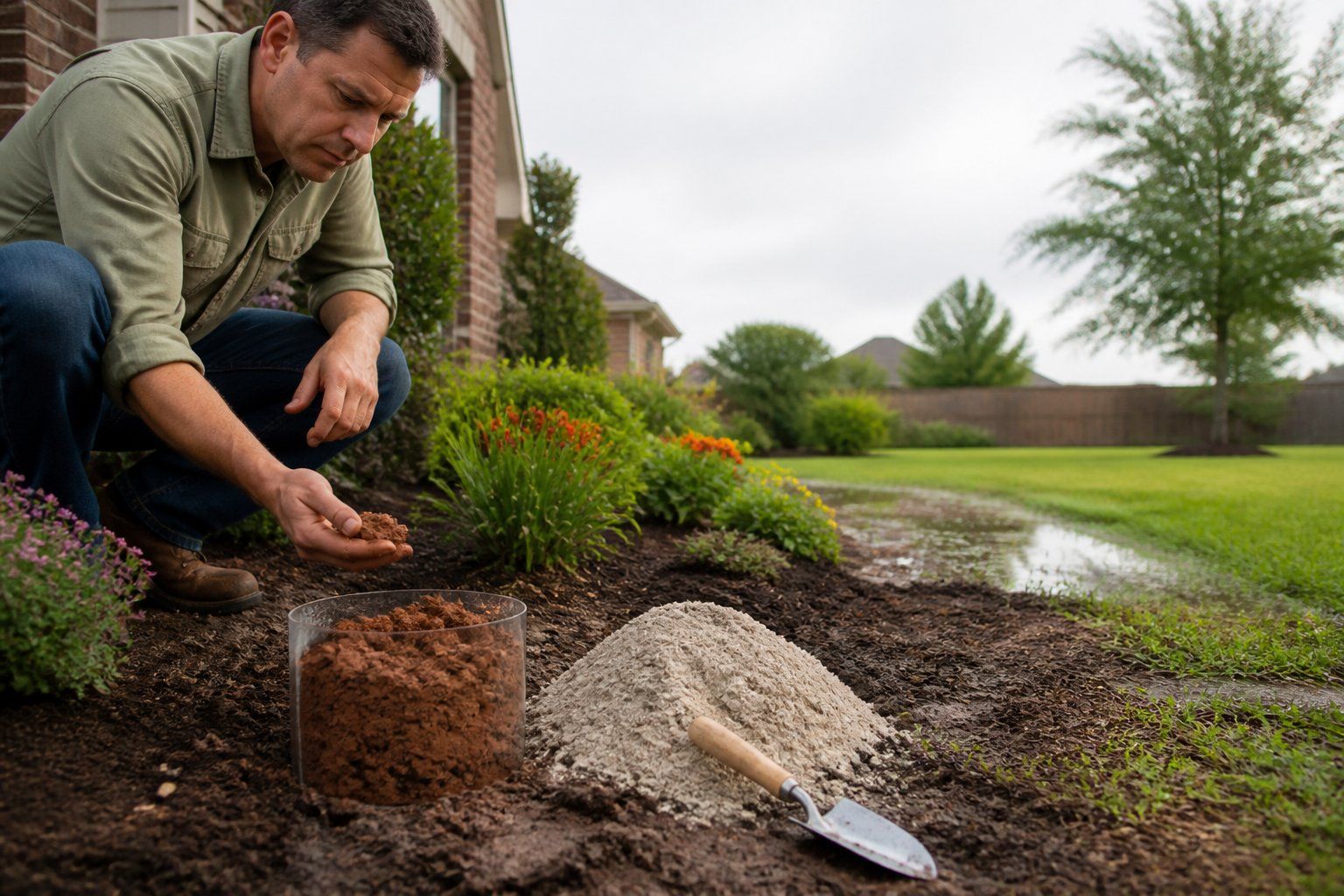
Two days after a heavy Cypress rain, part of your yard is still soft enough to leave footprints. The grass yellows, the beds smell sour, and shrubs you paid good money for start to fail. Somebody at the hardware store told you to buy sand and mix it in. Before you haul home twenty bags, it is worth knowing what that actually does to Houston-area clay.
PearceScapes has spent more than 10 years working in the heavy clay soils across Cypress, Bridgeland, and Towne Lake, and this is one of the most common questions homeowners ask.
Keep reading to learn why sand usually backfires, when a mineral amendment makes sense, and what to add instead. By the end, you will know whether your yard needs a soil fix, a grading fix, or a real drainage system.
The Straight Answer for Cypress Clay
No, adding sand to clay soil to improve drainage does not work in most home yards. In small amounts, it makes the ground denser and harder. To actually change how water moves, sand or grit has to make up roughly 50 percent or more of the total soil volume, and most homeowners never get close.
Gulf Coast clay makes this worse than it is in drier regions. Our clay swells when wet and shrinks and cracks in the Houston summer heat. That constant movement pushes fine particles back together, closing whatever gaps you thought you created.
Why a Few Bags of Sand Are Not a Drainage Fix
Spreading three or four bags over a bed changes almost nothing about soil texture. You end up with a thin sandy layer that holds water on top of unchanged clay below.
That layer can actually trap moisture. Water moves through the sand fast, hits dense clay, and stalls there. Roots sit in that wet zone, which is exactly what you were trying to avoid.
The Volume Needed to Change Soil Texture
Real numbers help. To improve just the top four inches of a 100-square-foot bed with grit, you need roughly one cubic yard of material, which weighs about 2,700 pounds dry.
Scale that to a 1,000-square-foot side yard, and you are moving well over a dozen tons and tilling it 8 to 10 inches deep. Most homeowners stop halfway, and a half-finished job performs worse than doing nothing. So what is happening down there when sand and clay meet in the wrong proportion?
Why Sand and Clay Can Create a Harder Mix
The problem is particle size. Clay particles are microscopic, and they fill the gaps between larger sand particles the way mortar fills gaps between bricks.
Once those gaps are packed, you lose pore space: the tiny air pockets roots need for oxygen and water movement. The mix ends up denser than the original clay soil, not looser.
Particle Size, Pore Space, and Water Movement
Good garden soil is roughly half solid material and half pore space. Water drains through the large pores, and air fills them once the water passes.
Add sand without enough volume, and clay coats every grain. The large pores disappear, the soil structure collapses, and compaction gets worse under foot traffic and mower weight.
How Fine Sand Turns Dense Clay Into a Concrete-Like Layer
Fine sand is the worst choice. Play sand and beach sand have rounded, uniform grains that nest together tightly instead of propping each other apart.
Mix fine sand into wet clay, and it sets up like a poor grade of concrete when it dries. Homeowners in Bridgeland and Towne Lake have hit that layer with a shovel a year later and could barely break it.
Angular material behaves differently, which raises a fair question: is there any version of this that works?
When a Mineral Amendment May Be Appropriate
Yes, but only with coarse, angular material and only in high volume. Horticultural grit or crushed stone in the 2 to 4 millimeter range has sharp edges that hold each other apart, keeping pore space open even under pressure.
This makes sense in a defined space, like a raised herb bed or a small area for plants that demand sharp drainage. It rarely makes sense across an entire lawn, where the cost and labor climb fast.
Choosing Coarse Sand or Horticultural Grit
If you go this route, apply 3 to 4 inches of coarse grit and mix it 8 to 10 inches deep with a tiller or spade. Add compost at the same time so you improve structure and biology together, not just texture.
Expanded shale is another option that performs well in Houston-area clay. It is lightweight, porous, and holds its shape instead of crushing back down.
Materials That Do Not Belong in a Clay Bed
Some materials cause more problems than they solve:
- Play sand and beach sand: fine, rounded grains that compact into a hard layer
- Builder's sand: often too fine and may carry salts or lime you did not plan for
- Pea gravel in thin layers: creates a perched water table instead of a drainage path
- Fresh manure: burns roots and ties up nitrogen right when plants need it
Mineral amendments are the expensive, labor-heavy path. A cheaper option works better over time.
Build Drainage With Organic Matter First
Compost is the single most reliable amendment for heavy clay soil. It feeds soil biology, and the resulting worm channels and root pores create drainage paths that sand never will.
The improvement is real but gradual. Expect noticeable change in one season and a genuinely different garden bed after two or three years of steady work.
A Repeatable Compost and Leaf Mold Routine
Apply 2 to 4 inches of compost, aged manure, or leaf mold each fall. Anything thinner than 2 inches makes almost no difference in clay.
Repeat it every year without skipping. Fall works well here because our mild winters keep soil organisms active while the beds rest.
How to Loosen a Garden Bed Without Damaging Its Structure
Work compost into the top 6 inches with a garden fork rather than a rototiller. Tilling grinds clay into smaller particles and destroys the structure you are trying to build.
Never work Cypress clay when it is wet. Squeeze a handful first: if it holds a ball, wait. If it crumbles when poked, you are clear to work.
Raised Beds for Fast Results Above Heavy Clay
Raised beds skip the problem instead of solving it. Build them 10 to 12 inches high and fill with roughly 60 percent topsoil, 30 percent compost, and 10 percent coarse sand.
Do not put landscape fabric under the bed. Roots and earthworms need to reach the clay so it slowly improves from below. Good root growth follows within the first season.
Amendments only help if soil texture is the real problem, and often it is not.
Diagnose the Water Problem Before You Amend
Many soggy Cypress yards don't have a soil problem at all. They have a compacted subsoil layer, a bad grade, or nowhere for water to go once it arrives.
New construction lots are a common culprit. Heavy equipment presses the subsoil into a hardpan 8 to 18 inches down, and no amount of surface compost reaches it.
Signs a Compacted Subsoil Layer Is Blocking Drainage
Push a screwdriver or metal rod into damp soil. If it stops hard at 6 to 8 inches, you have found the layer blocking clay soil drainage.
Other clues include water that pools for hours after rain and plants that yellow even with steady watering. Roots simply cannot get through. A broadfork or a contractor with a chisel plow can break that layer, but only when the soil is moderately dry.
When Surface Runoff, Grading, or a Drainage System Is the Real Issue
If water runs toward the house or collects in the same low spot every storm, that is a grading issue. Soil amendments will not redirect water that has no exit.
Downspouts dumping at the foundation, a neighbor's slope draining into your yard, and flat lots all call for a French drain, a catch basin, or corrected grading.
Where Gypsum Fits and Where It Does Not
Gypsum helps sodic soils, where sodium has broken down soil structure. Most Cypress clay is not sodic, so gypsum rarely changes drainage here.
Get a soil test before you buy it. Otherwise, you are treating a condition your yard probably does not have. That leaves one question: which fix does your yard actually need?
Choose the Right Fix Before Your Next Rainstorm
Match the fix to the symptom, not to the advice you heard last. Bed problems, lawn problems, and standing water problems have three different answers.
A Simple Decision Path for Beds, Lawns, and Persistent Pooling
Work through it in order:
- Beds drain slowly, plants survive: add 2 to 4 inches of compost each fall
- You want results this season: build raised beds over the heavy clay soil
- Lawn stays soggy for days: test for a hardpan layer, then break compaction
- Same spot floods every storm: the issue is grading or drainage, not soil improvement
- Water pools near the foundation: stop DIY work and get it assessed
Organic matter improves plant growth and root growth over years. Drainage work solves standing water now. Most Cypress yards need some of both.
When to Call for a Professional Cypress Drainage Assessment
Call when water reaches the foundation, when the grade slopes the wrong way, or when your yard stays wet after a full week of dry weather. Those are engineering problems, not gardening problems.
A professional assessment also catches things a homeowner cannot see, like buried builder debris or a collapsed drain line from a previous owner.
Frequently Asked Questions
Will adding sand to my clay soil actually improve drainage in a Houston-area yard?
Usually not. Small amounts of sand fill the pore space in clay and leave the ground denser than before. You would need sand or grit at roughly 50 percent or more of total soil volume to change drainage at all.
Why can mixing sand into clay soil make the ground harder and more compacted?
Clay particles are tiny enough to pack into the gaps between sand grains, like mortar between bricks. That removes the air pockets roots need. The result is hard soil, especially once Houston summer heat dries it out.
What should you add to clay soil instead of sand for better garden drainage?
Compost, leaf mold, and aged manure are the best choices. They feed soil biology, and the worm channels and root pores that follow create lasting drainage paths. Expanded shale also works well in Gulf Coast clay.
How much organic matter should you mix into clay soil to improve its structure?
Apply 2 to 4 inches of compost each fall and work it into the top 6 inches with a garden fork. Thinner layers make little difference. Plan to repeat this yearly for two to three years.
Does gypsum help break up clay soil in Cypress and Bridgeland landscapes?
Only if your soil is sodic, meaning sodium has damaged its structure. Most clay in Cypress and Bridgeland is not, so gypsum rarely improves drainage here. Run a soil test before spending money.
What type of sand is safe to use when improving drainage around plants or lawn areas?
Coarse, angular horticultural grit or crushed stone in the 2 to 4 millimeter range is the safest option. Avoid play sand, beach sand, and fine builder's sand entirely. Even coarse grit only helps when mixed 8 to 10 inches deep in high volume.
Getting Your Cypress Yard to Drain the Way It Should
The honest answer stays the same: sand isn't a shortcut. Compost, patience, and a correct diagnosis will do more for your clay than any bag of sand on the shelf.
If your beds are just slow, you can handle that yourself with a fork and a yearly layer of compost. If water is pooling in the same place every storm or creeping toward the house, the fix is drainage design, and guessing gets expensive.
You have done the research. Now get a plan built around your actual yard. Contact PearceScapes to schedule your free consultation , and we will walk you through what the work involves and what it costs.